
Matelas
Wake Up Refreshed: The Ultimate Technical Guide to Building Better Sleep Habits
Mar
Key Takeaways
- Circadian rhythm alignment and adenosine clearance dictate the neurochemical balance required for restorative sleep.
- Precise environmental factors, including thermoregulation and specific lux light levels, act as primary zeitgebers for sleep onset.
- Ergonomic support, specifically the structural integrity of your matlas (mattress), directly impacts spinal alignment and the continuity of NREM deep sleep.
- Systematic, protocolized sleep habits are essential for modulating autonomic nervous system arousal and optimizing sleep architecture.
Table of Contents
- Introduction: The Neurobiology of Waking Up Refreshed
- Body Section 1: Decoding Sleep Architecture and Circadian Rhythms
- Body Section 2: Environmental Engineering and Matlas Ergonomics
- Body Section 3: Protocolizing Neurochemical-Friendly Sleep Habits
- Conclusion: Synthesizing Your Sleep Optimization Strategy
- Frequently Asked Questions (FAQ)
Introduction: The Neurobiology of Waking Up Refreshed
Acute sleep deprivation significantly impairs glymphatic clearance, the brain’s macroscopic waste clearance system, leading to immediate deficits in cognitive processing, motor function, and long-term neurodegeneration. When we fail to achieve restorative rest, metabolic byproducts such as beta-amyloid and tau proteins accumulate within the interstitial spaces of the central nervous system. Therefore, optimizing sleep is not merely a lifestyle choice; it is a fundamental biological imperative.
In clinical and neurobiological contexts, we must define « sleep habits » not merely as passive bedtime routines, but as critical behavioral interventions that directly modulate neurochemistry and endocrine function. The actions you take throughout the day and the specific parameters of your sleep environment serve as inputs that dictate your neurochemical output.
Furthermore, waking up « refreshed » is not a subjective feeling but a measurable physiological state. It is characterized by complete adenosine clearance from the basal forebrain and an optimized Cortisol Awakening Response (CAR), which provides the necessary autonomic arousal to transition from sleep to wakefulness.
Achieving peak restorative sleep requires a systematic, technical approach to sleep architecture, environmental engineering, and behavioral conditioning. By protocolizing these elements, you can hack your endogenous rhythms to ensure maximum physiological recovery.
Body Section 1: Decoding Sleep Architecture and Circadian Rhythms
To engineer better sleep habits, one must first understand the fundamental mechanics of the two-process model of sleep regulation. This model is governed by the continuous interaction between Process C and Process S. Process C represents the Circadian Rhythm, an endogenous 24-hour oscillation driven by the suprachiasmatic nucleus (SCN) in the hypothalamus. The SCN relies on external cues, or zeitgebers, to synchronize internal biological time with the external environment. Conversely, Process S represents Sleep Homeostasis, which is driven by the gradual accumulation of adenosine—a byproduct of cellular ATP metabolism—in the brain during wakefulness. The higher the adenosine concentration, the higher the homeostatic sleep pressure.
When sleep initiates, the brain cycles through highly specific stages of polysomnography, broadly categorized into Non-Rapid Eye Movement (NREM) and Rapid Eye Movement (REM) sleep. NREM is further subdivided into N1, N2, and N3. N3, also known as slow-wave sleep (SWS), is defined by high-amplitude delta waves (0.5–2 Hz) and is the critical window for cellular repair, growth hormone secretion, and the flushing of neurotoxic waste via the glymphatic system. REM sleep, characterized by beta-like electroencephalogram (EEG) activity and muscle atonia, plays a distinct, vital role in emotional memory consolidation and neuroplasticity.
Irregular sleep habits inevitably desynchronize the endogenous clock. When sleep timing fluctuates, the SCN receives conflicting signals, leading to blunted melatonin secretion profiles from the pineal gland. Melatonin is the neurohormone responsible for signaling the biological night; a blunted profile results in delayed sleep onset latency and fragmented sleep architecture.
Furthermore, these protocols must be customized based on individual chronotype variations. A chronotype dictates the timing of an individual’s minimum core body temperature (Tmin), which typically occurs about two hours before natural waking. Aligning your sleep window to bracket this Tmin is essential for maximizing slow-wave sleep efficiency. Forcing a delayed chronotype into an early sleep window inevitably leads to circadian misalignment and sub-optimal recovery.
Body Section 2: Environmental Engineering and Matlas Ergonomics
Sleep is an environmentally dependent state. The physical parameters of your bedroom dictate the autonomic nervous system’s ability to downregulate. The foremost physiological necessity for sleep onset is thermoregulation. A core body temperature drop of 1 to 2 degrees Fahrenheit is required to initiate and sustain NREM sleep. If the ambient environment prevents this thermal offloading—typically achieved via vasodilation in the distal extremities—the brain will struggle to transition past the superficial N1 and N2 stages.
Equally critical is the management of photic stimuli. The human retina contains intrinsically photosensitive retinal ganglion cells (ipRGCs) that express the photopigment melanopsin. These receptors are highly sensitive to blue light wavelengths, specifically in the 460-480 nm range. Exposure to high-lux blue light from screens or modern LED lighting in the hours preceding sleep aggressively suppresses melatonin synthesis in the pineal gland, artificially extending Process C’s wakefulness signal despite high Process S homeostatic pressure.
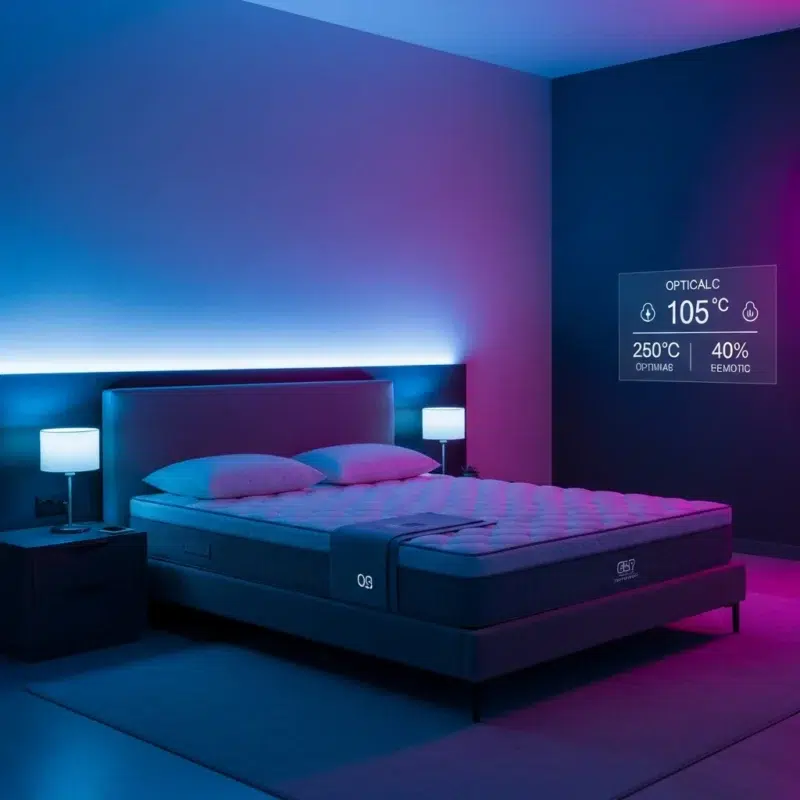
Beyond temperature and light, the biomechanical importance of your sleep surface cannot be overstated. Advanced matlas (mattress) materials play a critical role in mitigating involuntary micro-awakenings. A micro-awakening is a transient shift in EEG frequency lasting 3 to 15 seconds, often imperceptible to the sleeper, but devastating to the continuity of slow-wave sleep.
Proper matlas ergonomics facilitate optimal pressure redistribution and maintain neutral spinal alignment throughout the night. If a matlas lacks adequate structural integrity or localized support, it creates pressure points at the hips and shoulders. This mechanical stress triggers nociceptive (pain) signaling to the brain. Even if this signaling does not cause full wakefulness, it prompts sympathetic nervous system arousal, shifting the brain out of restorative N3 sleep and back into lighter N1 or N2 stages. Therefore, investing in a highly engineered matlas is a fundamental requirement for protecting sleep architecture.
Body Section 3: Protocolizing Neurochemical-Friendly Sleep Habits
To permanently alter sleep neurochemistry, one must apply evidence-based principles of Cognitive Behavioral Therapy for Insomnia (CBT-I). Two of the most potent technical interventions are stimulus control and sleep restriction therapy. Stimulus control aims to strengthen the neurological association between the bed and sleep. This means utilizing the matlas strictly for sleep, thereby extinguishing conditioned hyperarousal. Sleep restriction therapy temporarily limits time in bed to match actual sleep time, thereby driving up homeostatic sleep pressure (Process S) and consolidating fragmented sleep architecture.
Implementing a chronobiologically aligned pre-sleep protocol is equally vital. This involves the timed attenuation of ambient light—dimming environmental lux levels to below 50 lux at least 120 minutes prior to sleep onset. Thermal manipulation can also be leveraged; for example, taking a warm bath 90 minutes before bed artificially raises peripheral skin temperature, which subsequently triggers a rebound peripheral cooling effect, rapidly dropping core body temperature to induce sleepiness. Coupled with cognitive offloading techniques, such as journaling to downregulate default mode network (DMN) hyperactivity, these habits create an optimal runway for sleep.
We must also quantify the pharmacokinetic impact of exogenous inputs on sleep habits. Caffeine acts as a competitive antagonist at the A1 and A2A adenosine receptors. With a half-life of 5 to 7 hours in healthy adults, late-day caffeine consumption blocks the brain’s ability to perceive accumulated sleep pressure. Alcohol, while acting as a central nervous system depressant via GABA receptor agonism (reducing sleep onset latency), severely disrupts sleep architecture. It acts as a potent REM sleep suppressor during the first half of the night and causes glutamatergic rebound arousal in the second half, destroying sleep continuity.
Finally, the protocol does not end at night. Morning bright light exposure is the most powerful zeitgeber for the human circadian clock. Viewing 10,000 to 100,000 lux of full-spectrum light (ideally natural sunlight) within 30 minutes of waking anchors the circadian rhythm. This exposure triggers the morning cortisol pulse, the Cortisol Awakening Response (CAR), which clears residual sleep inertia and sets a 14-to-16-hour timer for the onset of melatonin secretion later that evening.
Conclusion: Synthesizing Your Sleep Optimization Strategy
Building better sleep habits is a precise, measurable science dependent entirely on neurochemical and environmental alignment. It is not a matter of willpower, but a matter of biological engineering. By respecting the two-process model of sleep regulation, you can systematically control the inputs that dictate your rest.
The integration of circadian tracking, optimized matlas ergonomics, and strict behavioral protocols yields cumulative physiological benefits. Thermoregulation, precise light exposure, and biomechanical support work synergistically to clear adenosine, secrete melatonin, and protect the fragile continuity of deep slow-wave sleep.
Ultimately, you must view sleep not as a passive state of rest, but as an active, highly structured biological process. It requires rigorous daily protocolization. By adopting this technical approach, you ensure that every night yields maximum cellular repair, cognitive consolidation, and a mathematically optimized state of waking up truly refreshed.
Frequently Asked Questions (FAQ)
Q: How does adenosine accumulation affect sleep drive?
A: Adenosine is a byproduct of cellular metabolism (specifically ATP breakdown) that accumulates in the basal forebrain during wakefulness. As it accumulates, it binds to specific A1 and A2A receptors to inhibit arousal-promoting neurotransmitters (like orexin and histamine) while stimulating sleep-promoting neurons. This mechanism increases homeostatic sleep pressure, compelling the brain to transition into sleep.
Q: What is the optimal ambient room temperature for optimal sleep architecture?
A: Clinical data suggests an ambient temperature between 60-67 degrees Fahrenheit (15-19 degrees Celsius) optimally facilitates the necessary drop in core body temperature required to transition into deep NREM sleep. Temperatures outside this range force the autonomic nervous system to expend energy on thermoregulation, leading to fragmented sleep.
Q: How does matlas (mattress) firmness directly affect NREM sleep continuity?
A: An ergonomically appropriate matlas prevents excessive localized pressure and musculoskeletal misalignment. If a matlas is too firm or too soft, it induces nociceptive (pain) signaling to the brain. This signaling causes involuntary micro-awakenings and sympathetic arousal, which fragments slow-wave (NREM) sleep and prevents the brain from achieving deep restorative states.
Q: Can exogenous melatonin supplementation correct poor sleep habits?
A: Melatonin acts primarily as a chronobiotic (a phase-shifter) rather than a strict soporific (sedative). While it can help signal the biological night and adjust circadian timing, it cannot override the physiological arousal caused by poor behavioral habits, late-night caffeine consumption, or high-lux blue light exposure. It is a supplement to, not a replacement for, proper sleep protocols.